
The Monnin Case II: How Over 100 Brands Shared the Same Iconic Dive Case
One case design. One corner of the Jura Canton bordering the Franche-Comté. Almost half a century of dive watches, spread across the globe under dozens of names.
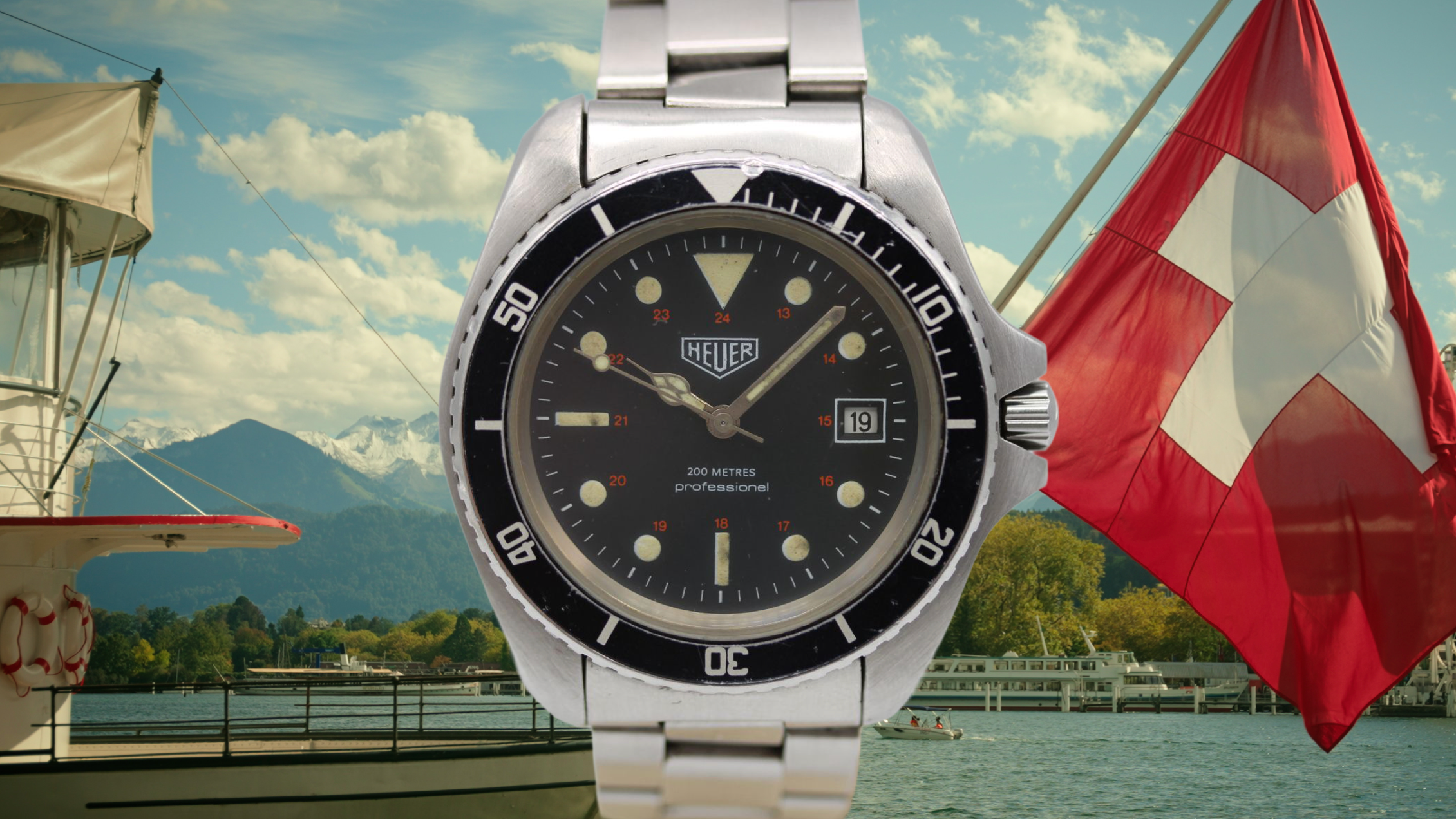
Heuer’s Ref. 844, their first dive watch
Late last year, I published an article in Oracle Time Magazine which catalogued something quite dormant in the tool watch space for many decades: a single case design, originating from the Swiss manufacturer MRP, had been quietly adopted by a remarkable number of watch brands throughout the late 1970s until today. That piece, which is the prequel to this longer write-up, named some of the most obvious iconic models from Chronosport, military divers for the Royal Navy and Marine Nationale, and some modern revivals.
But the truth is the Monnin case was used by over 100 brands who each shared details and components as part of the white-labeled production of divers at the time.
Toolwatch Project's own database now documents over 110 distinct brands that used what collectors have come to call the “Monnin” diver case (there are doubtlessly more brands yet to be added). They range from household names you would find in any mainstream watch reference: Breitling, Heuer, Zenith, Hamilton, Sinn, Zodiac; to deeply obscure regional labels that may risk being forgotten: ZRC/Zeder, J. Paul Monet, Jopel, Geota; the list literally goes on-and-on.
Taken together, this catalogue tells a story not just about a case shape, but about how the Swiss watch industry actually functioned during one of its most turbulent and creative periods.
A Case and Bezel Becomes a Platform
The Monnin diver case, produced by MRP, based near the Swiss-French border, was never glamorous in the way that Rolex or Blancpain cases were. It was slab-sided, un-sculpted, chunky and square. Its defining features were practical: substantial crown guards (often a characteristic “deep-V” profile in early versions, later evolving to a more squared form), solid lug construction, a unidirectional ratcheting bezel (patent 503.305), and water resistance credentials that made it genuinely useful for the sport diving market that was booming in the 1970s. It was a tool watch in the truest sense.
Despite MRP’s famous 503.305 bezel patent, what made it remarkable was not any single feature but its adaptability. It could be finished in standard steel or PVD. It could be fitted with any kind of off-the-shelf movement, usually time and date variations, but also chronographs (the distinctive ‘Chrono-Monnin' variants), sometimes with pushers at 4 and 8 o'clock seen on the Scubapro examples among others.
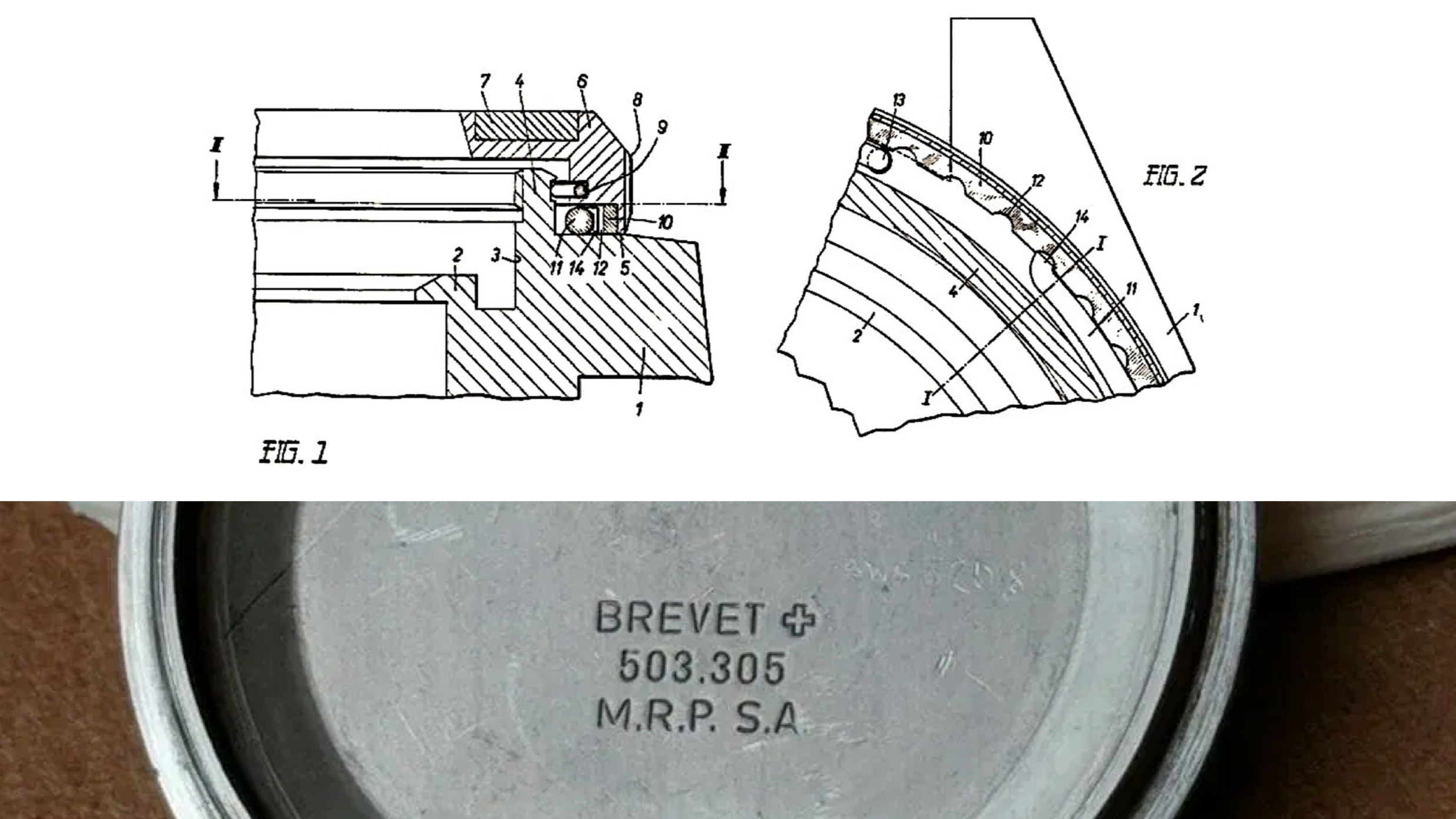
MRP’s bezel patent and inside caseback stamp (used on Monnin cases as well as other designs)
The bezel was equally flexible: the database includes examples with the common acrylic inserts in black, yellow, red, “Pepsi” and “Coke”, and aluminium bezels of all kinds, even no-decompression variants, as well as larger “buzz saw” serrated bezels taken from MRP’s ‘1000’ designs, as well as coin-edge bezels paired with a thinner case variant.
The case was, effectively, a platform - one that a brand could personalise through its choice of dial, hands, bezel, and finishing. The case could even accommodate different crown positions - examples with crowns at 3 o'clock being most common, but 4 o'clock crowns do appear, albeit very rarely (only with an earlier Adina model and a later Solivil Et Titus so far).
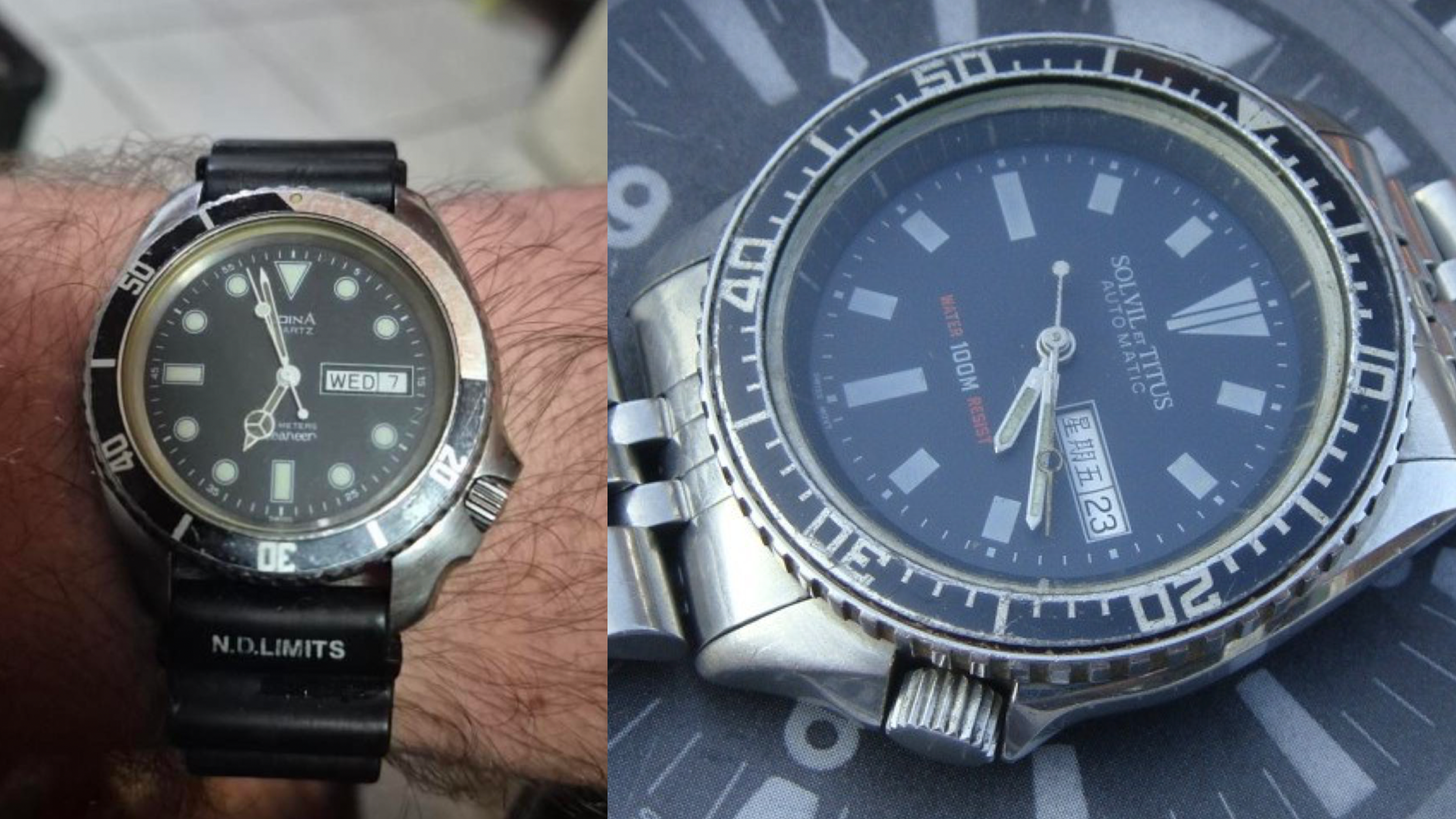
Monnin cases with 4 o’clock crowns
The point is that that platform quality of the case production explains, in large part, why so many brands chose it. For a small or medium-sized watch company in the belly of the Quartz Crisis, commissioning an entirely bespoke dive watch case was an expensive and complicated undertaking. Sourcing a proven, production-ready case from MRP and applying your own dial, your own hands, and your own branding was a far more practical route to market. The Monnin case made the dive watch segment accessible to brands that would otherwise have been unable to enter it.
Supply Chain Geography
The geographic dimension of the story is telling. The Jean-Louis Frésard workshop, documented in the database as potentially sharing production roots with the MRP factory itself, is located in Charquemont - directly on the Swiss-French border in the Doubs department. This is the heartland of the traditional watchmaking corridor that stretches from Besançon into the Swiss Jura. MRP operated within this same ecosystem, and the concentration of related brands and suppliers in this compact region reflects how vertically clustered Swiss watchmaking had always been.
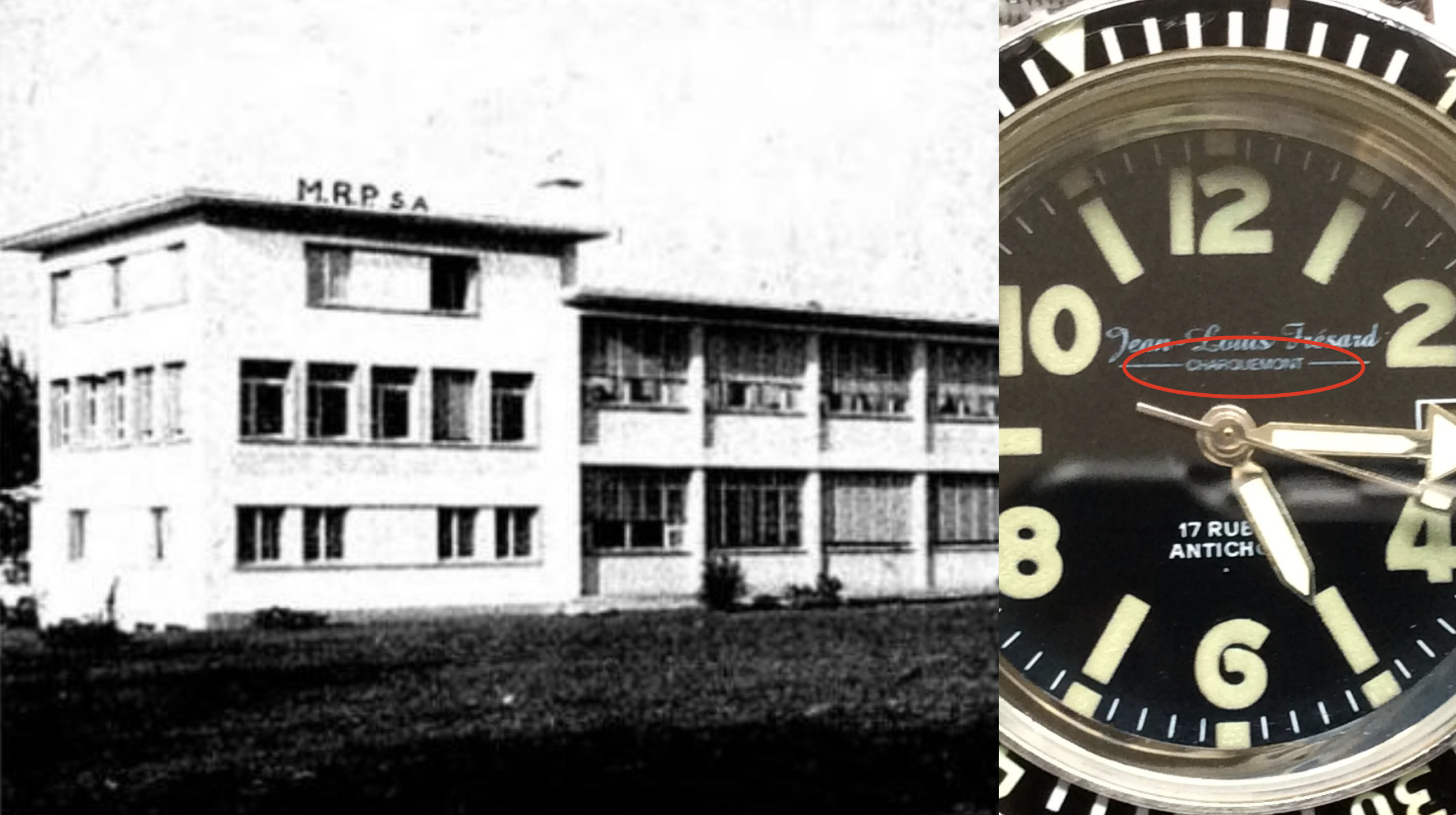
MRP’s original factory in Alle, Switzerland (left) and a dial referencing Charquemont, France (right) - less than 50km apart
Production was sometimes routed through intermediaries rather than going directly from MRP to a brand. Dodane is a French company known for making precision instruments for the military and aviation sectors, perhaps most famous for being a key manufacturer of the legendary Type 20 and Type 21 chronographs. The firm appears to have acted as an intermediate producer for at least three Monnin brands: Airin, Camif (the watch-buying arm of a French dive school), and the Cabot Watch Company (CWC). CWC held Royal Navy supply contracts from around 1980, after Omega and Rolex had held them.
The CWC connection is particularly intriguing: the Royal Navy's dive watches, procured via a British contractor and assembled with Dodane's involvement, were built around the same fundamental case architecture as watches sold commercially in Australia, Germany, Canada, and France, albeit the only version with fixed lugs, as far as I can tell.
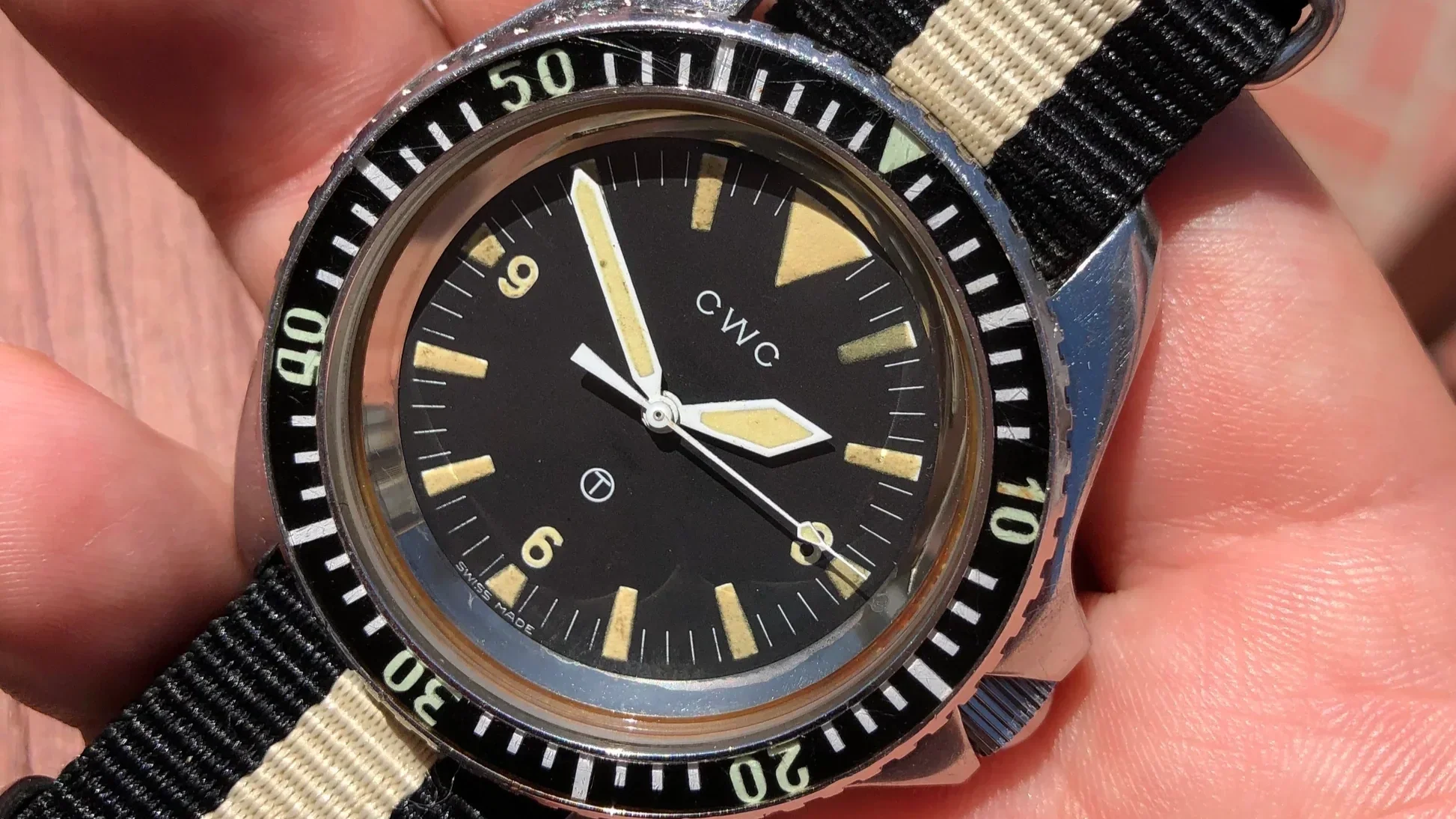
1981 CWC Royal Navy dive watch, produced via Dodane
That same supply chain logic explains brands such as Beuchat, the French diving equipment company, whose connection to the MRP 1000 case with its distinctive “buzz saw” bezel was well-established in the dive watch world at the same time. The Marine Nationale (French Navy) is documented as having also procured Beuchat-branded Monnin-cased watches for their base in Brest. Luxia and Le Forban appear as MN procurements also. What emerges is a picture of military and professional procurement flowing through exactly the same commercial channels as the retail market - a single supply chain serving admiralty requirements and high-street watch retailers alike.
The Brands Themselves: A Taxonomy
Running the ever growing list of brands through any kind of analytical lens produces a striking taxonomy.
At one end sit the prestige names. Breitling appears with both standard and chronograph variants, including the iconic ana-digi Pluton models (which were behind Chronosport’s UDT, often comingwith a Brietling-signed crown and inner caseback engraving). Heuer's presence is notable the Ref. 844 being Heuer's first dive watch. Zodiac used the case for some of their ‘red point’ divers’ range. Zenith used it for its Defy Quartz diver. Hamilton appears with a black PVD variant with a CWC-style aluminium bezel, and a date-day movement; a similar look and feel to CWC’s SBS divers.
Sinn used it for the Ref. 805, which groups into a 'German Trio' alongside VDST (the German Diving Society's branded watch) and Benora, the historic German ship clock manufacturer. That these three German-market watches all shared the same base case and components while serving quite different purposes - a consumer brand, an institutional procurement, and a maritime specialist - illustrates the breadth of applications the Monnin case supported. Note also a ‘US Army Special Forces’ branded version very similar to the German Trio.

A predominantly German cohort of Monnin divers sharing components
The brands even extend as far as Finland. Leijona (which means Lion in Finnish) has both an original 1980s version and a modern revival. A second recorded Finnish brand, Tiger, also appears on the list.

Finnish brands
At the other end of the taxonomy are the genuinely rare. ZRC’s Zeder is very rare, in early MRP versions with “deep-V” crown guards and matte deep-teal dials (possibly topicalised from black). J. Paul Monet’s utterly beautiful version has surfaced only once via a Reddit post, a chronograph Monnin variant with a split-second ETA 251.262 movement and a compass bezel and subtle orange highlights. The Yamaha version (yes, that Yamaha) is essentially the same as the J. Paul Monet, but with a brown PVD case, with a 'SPECIAL SERIES' engraved caseback and a yellow dial with compass chapter ring. Whether this represents a Japanese corporate promotional piece or something else entirely remains uncertain.
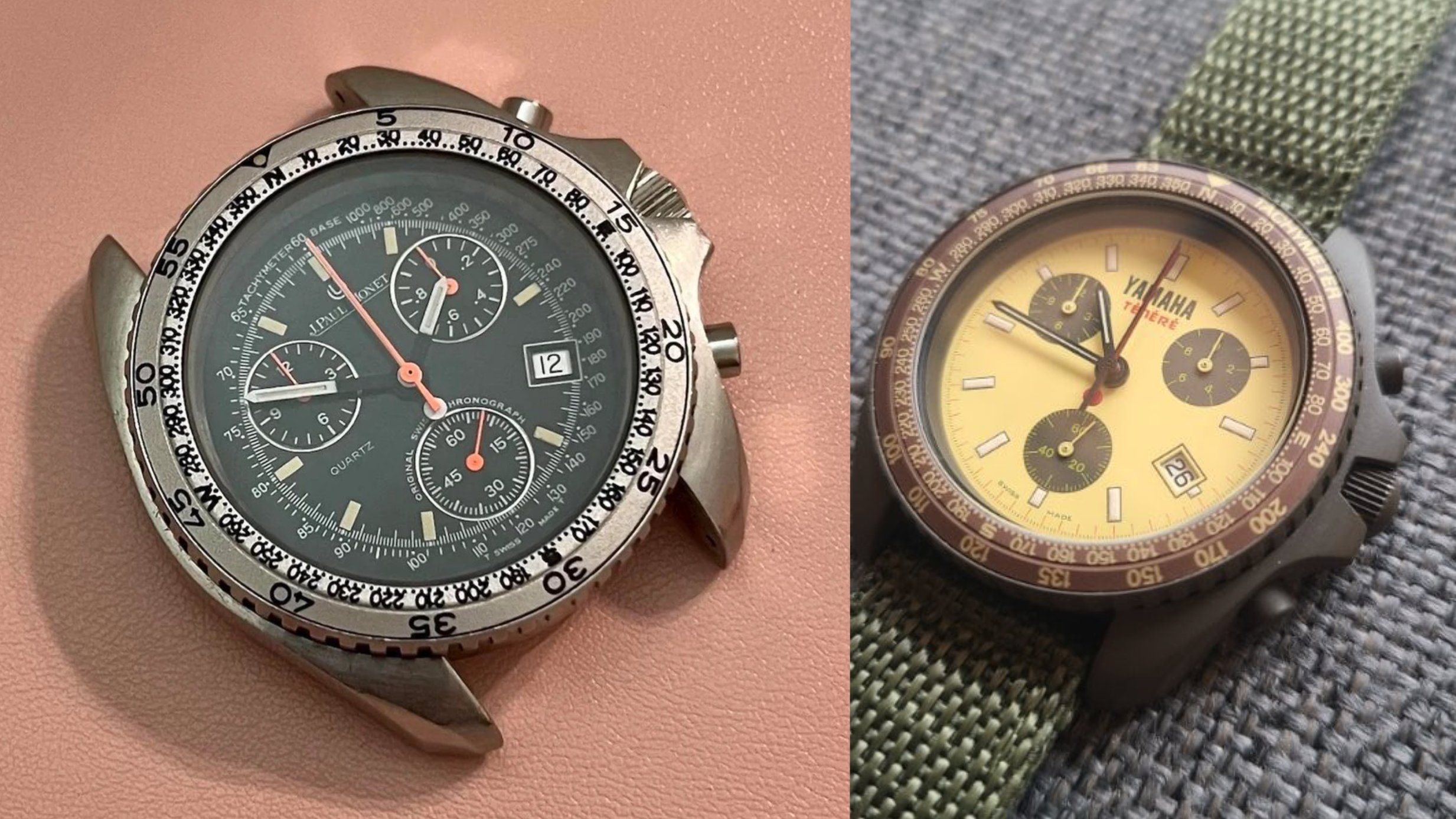
Split-second chronograph examples, both in Monnin cases and using ETA’s 251.262 movement
Between these poles sit the workhorse brands: regional and national labels that used the Monnin case to compete in the mass dive watch market of the late 1970s and 1980s. Aquadive and Candino, who are potentially connected cosmetically. HGP, or Hommes Grenouilles de Paris (the Paris Frogmen), has an original 1980s production and modern revivals.
From the 2000’s, Barracuda and Dive Dynamics (a UK-based diver service agency), confirmed as sharing the same configuration: the SKX-style cluster - Adina, Barracuda, Beuchat, Verteka, Poseidon, Holdive International - all sharing the variation with distinctive hour markers, hands and red 20-minute bezel insert. I consider this a copy of Seiko’s popular SKX models of the time.
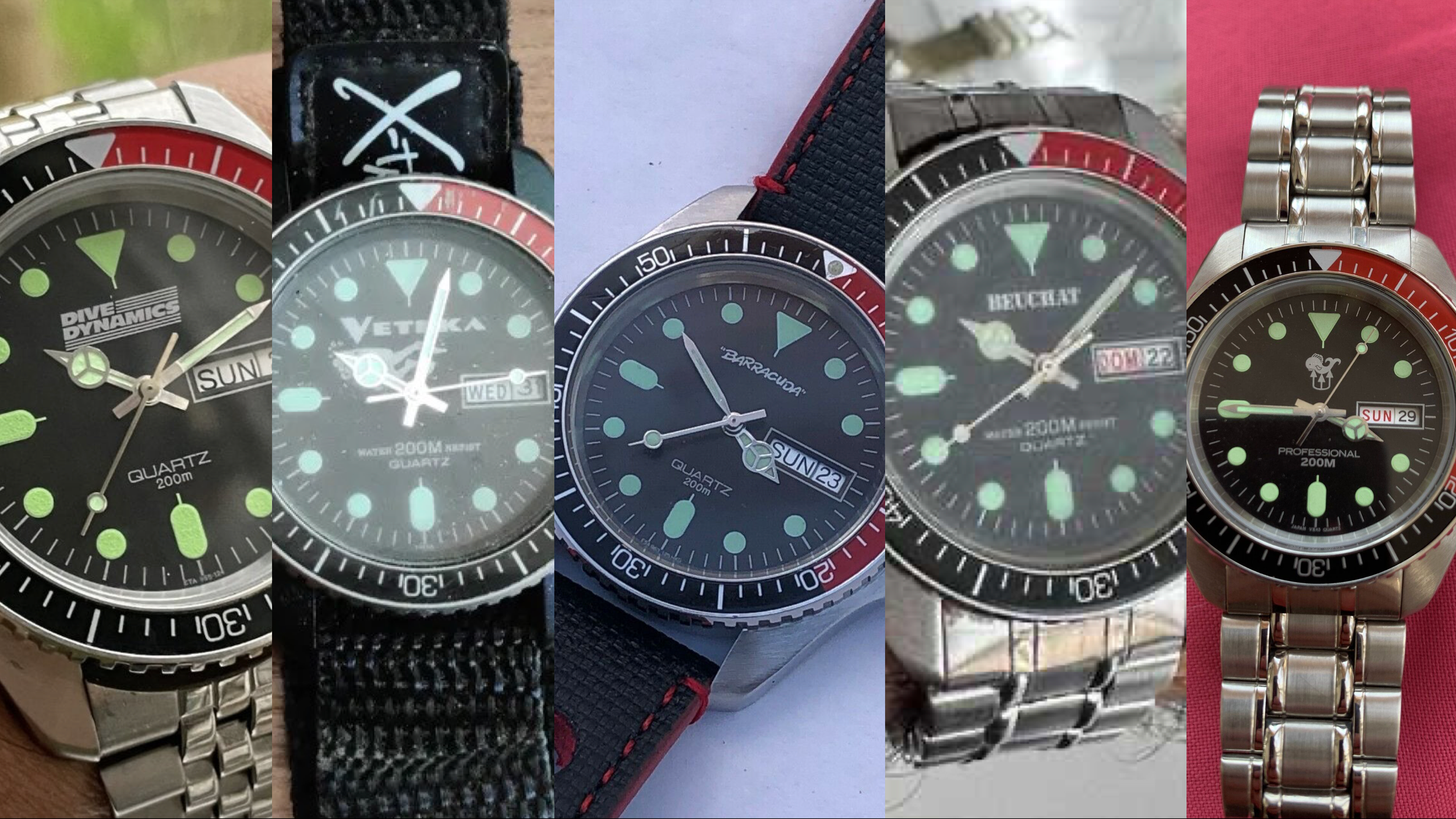
Some of the 00’s production Monnins with Seiko SKX-like features
At leaste three more brands - Precibel, Lancaster, and Oriosa - share a similar acrylic bezel inserts with dots instead of dashes, often with coin-edge bezels and a thinner-than-usual case.
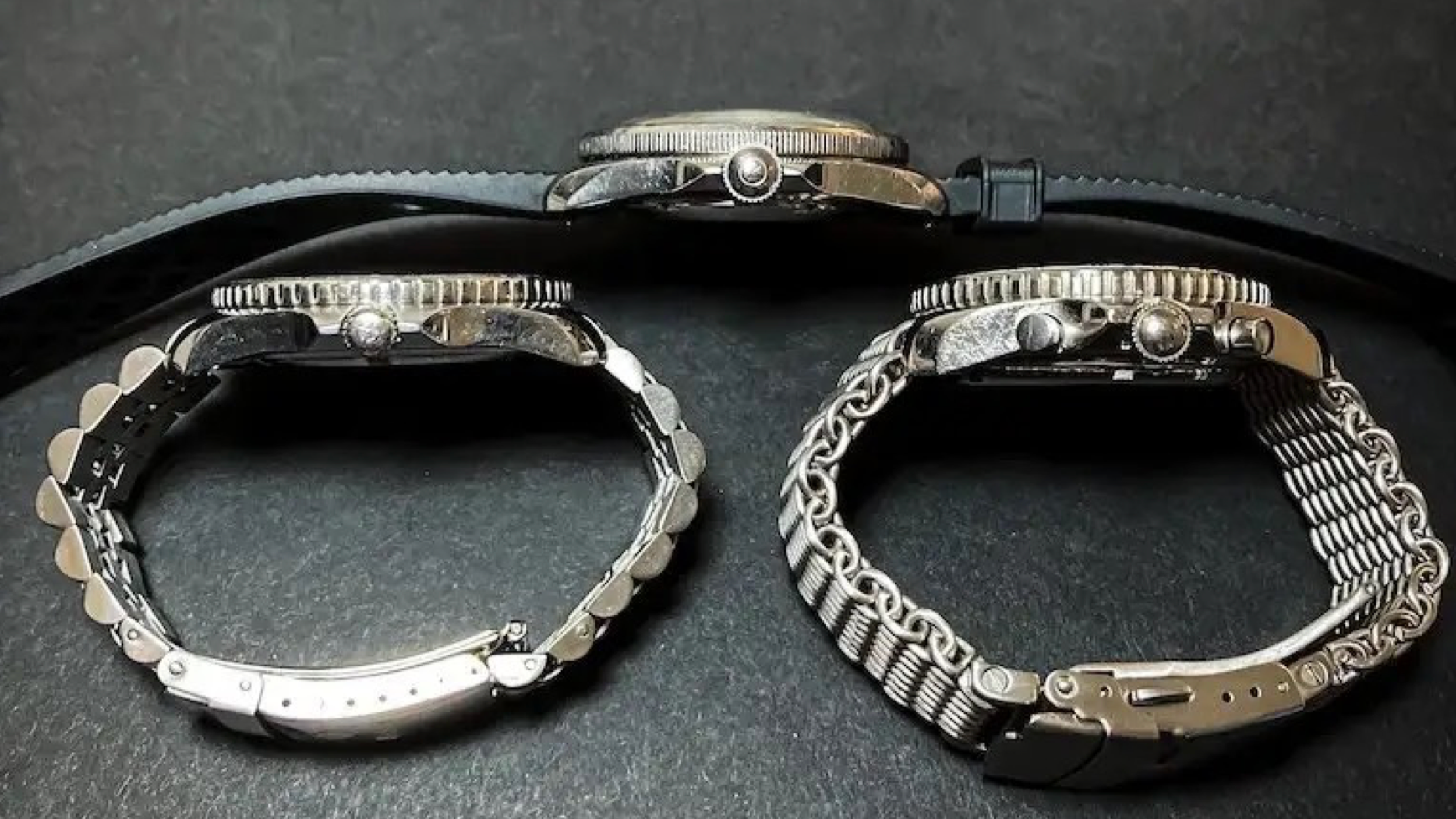
Variations in relative case thicknesses, bezels and crystals
Dial Patterns
One of the more productive avenues for future research that the database opens up is the analysis of dial patterns as a means of tracing production relationships. Several recurring dial types appear across multiple unconnected brands, suggesting watches that may have come from the same assembly line at MRP with only the name changed.

A few of the many brands who used a red 24 hour dial variation of the original MRP Monnin diver
The “red 24-hour” dial configuration is popular - black dial with a red 24-hour scale and typically either cathedral or Triton Spirotechnique-style hands. The most well known brands using the “red 24-hour” dial configuration are Heuer’s first fun of 844’s and George Monnin’s version; both of these brands became nick-namesakes for the case. But the “red 24-hour” appears under at least a dozen brand names: Ambre, Bessa, Comtex, Delbana, Diese, Landeron, Le Cheminant, Reglex, Rodania, Urech, Vedette, and Vuillemin Regnier. Some of these are French, some Swiss, some of uncertain origin. The hands and dial printing vary in detail, but the essential design is consistent enough to suggest a common source.
The "Sea Quartz 30” style dial - named after the Chronosport Sea Quartz 30, the Canadian brand that arguably gave this variant its most prominent outing - appears under Chronosport, Marty, Nilax, Roamer, Tegra, and Verity.
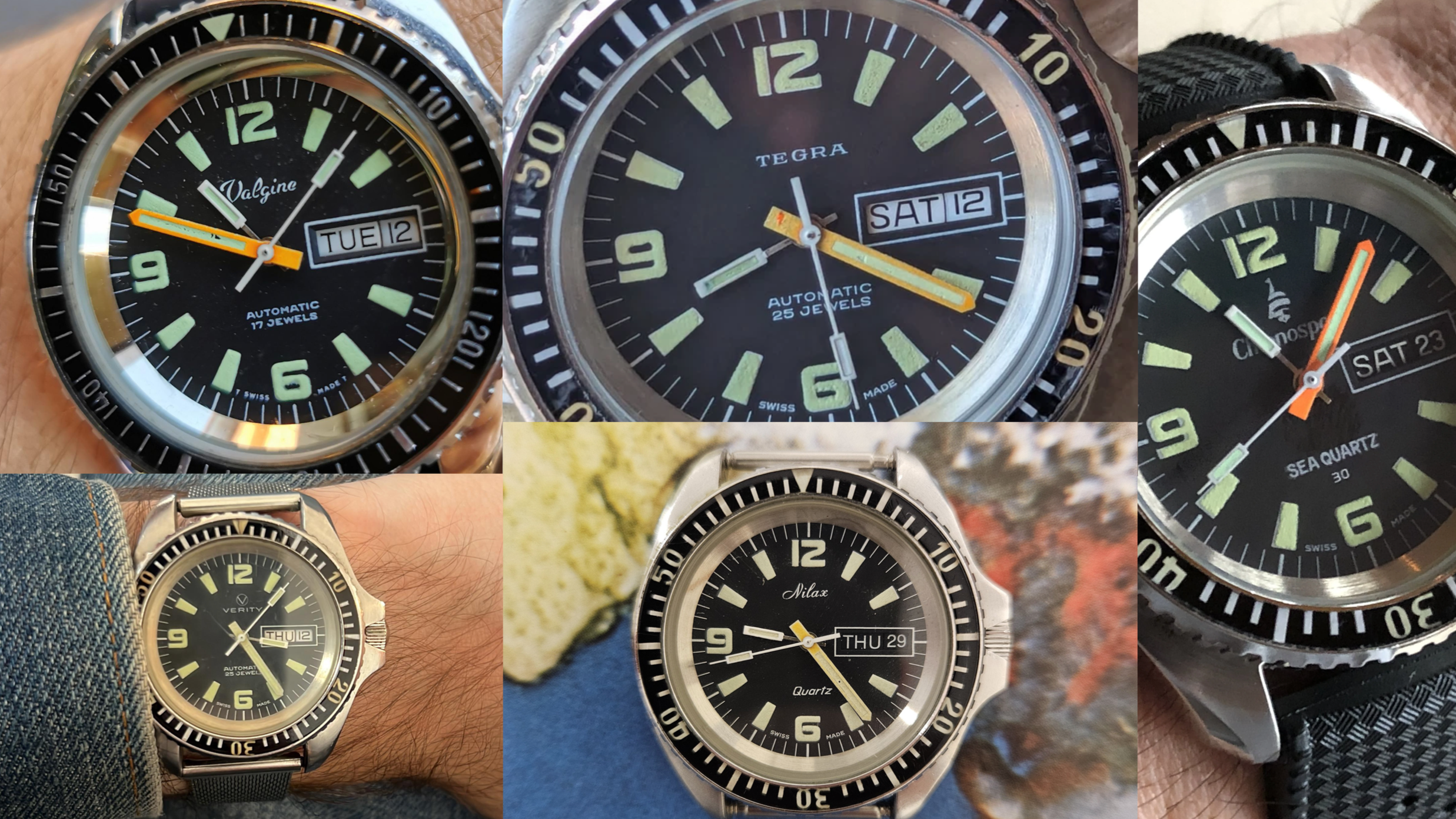
Brands sharing the Sea Quartz 30 dial variation
The “Divingstar” style' dial - named after Doxa’s yellow dial with black indices and hands (itself used, funnily enough, by the MN’s dive school), appears under the City and Antima brands.
The aforementioned “SKX-style” dial cluster, with red 20-minute bezel inserts, links Adina, Barracuda, Beuchat, Dive Dynamics, Holdive, Poseidon, and Verteka into what appears to be a coherent production group in the 00’s.
These are not coincidences of design. They are, in all likelihood, the fingerprints of shared production.
Military, Institutional, and Professional Procurement
Perhaps the most underappreciated dimension of the Monnin case story is its role in professional and institutional procurement. The dive watch market of the 1970s and 1980s was not purely a consumer market. It was also a procurement market for navies, military units, sport diving organisations and commercial diving operations.
The Marine Nationale appears multiple times - procured notably from Le Forban and Luxia, both using the Monnin case. CWC's Royal Navy production is extensively noted, with the observation that early production runs were sourced via Dodane (more on CWC can be found via the incredible work of Jonathan Hughs of cwcaddict.com). Navy SEALs also famously took to Chronosport’s UDT.
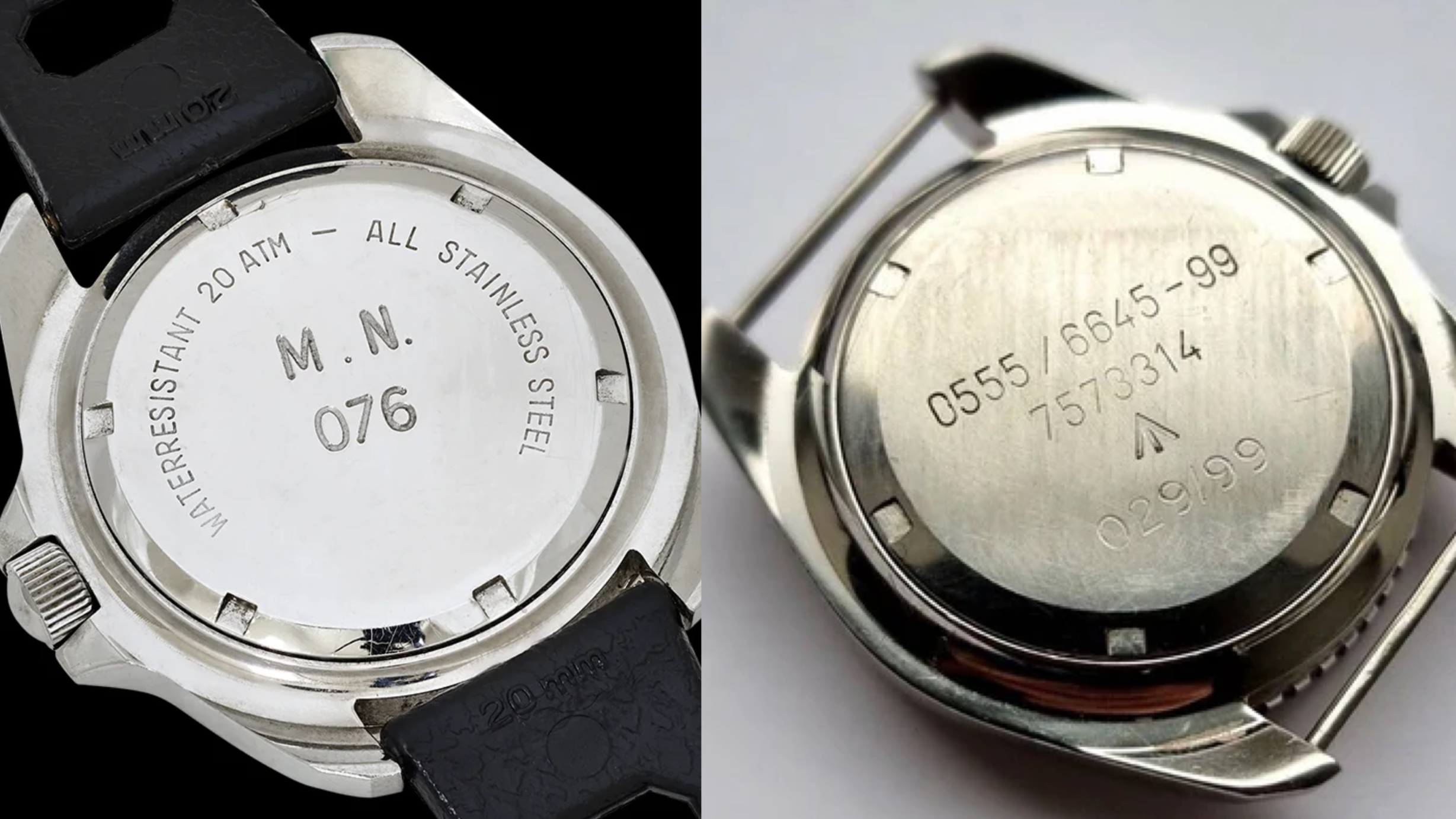
Caseback markings of a Marine Nationale Le Forban (left) and a Royal Navy CWC RN (right)
La Spirotechnique - the diving equipment company founded within the Air Liquide group, directly connected to the development of the Aqua-Lung - appears with a Spiroquartz-branded version using an ESA 536.121 movement, with “deep-V” crown guards consistent with early MRP production.
Camif, identified as a French dive school, had its own branded version, probably produced by Dodane.

La Spirotechnique (left) and Camif (right) branded Monnins
VDST, the Verband Deutscher Sport-Taucher, the German sport diving federation, had its own branded version which we’ve seen sitting alongside the Sinn Ref. 805 and the Benora (a German maritime clock company) in what we might call the “German Trio”.
This pattern of dive organisations, clubs, and professional bodies commissioning their own branded versions of a standard case is consistent with wider practices in the sport equipment industry of that era, and indeed many many industries to this day. But its scale here is striking. The Monnin case was, in a meaningful sense, the institutional dive watch platform of its generation and therefore a real-deal tool watch.
What This Tells Us About Swiss Watchmaking
The broader significance of this combing extends beyond horology. It is a case study (pun fully intended) in how a mature industrial ecosystem functions: not through the isolated genius of individual brands, but through a dense network of shared components, regional supply chains, intermediary producers, and flexible platforms.
The narrative of Swiss watchmaking is often told in terms of maisons and movements: the great manufactures that controlled every stage of production, the legendary calibres that defined generations of watches. The Monnin story tells a different and equally true version: one of practical industrialism, of workshops supplying multiple competing clients, of a case design that became a standard precisely because it was good enough and flexible enough to serve everyone from the Marine Nationale to a Queensland dive shop.
The Quartz Crisis of the mid-1970s sharpened this dynamic. As Swiss brands struggled to compete with Japanese electronic movements on price, the pressure to reduce costs in every dimension of watch production intensified. Sharing cases - proven, tooled, production-ready cases that could be personalised through dials and branding - was one rational response. The 100+ brands in this database so far were not all making the same commercial calculation, but many of them were, and the Monnin case was the infrastructure that made it possible.
What Remains Unknown
The database represents the current state of active research (or perhaps just pure nerdery), not a definitive record. Several entries carry explicit uncertainty since I cannot always get my hands on watches in-the-flesh, or even good quality photos.
The link between Aquadive and Candino is noted as a question. The connection between Jean-Louis Frésard and the MRP factory is flagged as speculative. The existence of a Broadarrow/Zeno/Zentra succession which was apparently triggered by an Omega trademark objection is noted but not fully resolved (this was brought to light by a comment on my original Oracle Time article).
There are also brands in the list where almost nothing is currently known beyond the fact of their existence. Each of these represents a thread that further research might pull.
Crucially, the connection with Ollech & Wajs, a Zurich-based watchmaker famous for their divers, who possibly produced Monnin cases independently of MRP. This suggests that the production network may have been even more complex than current evidence indicates.
Conclusion
My original Oracle Time article introduced the idea that many apparently distinct dive watches shared a common architectural origin. This deep dive (yes, another fully-intended pun) shows that the phenomenon was considerably more widespread than initially documented: at least 113 brands, spanning at least four decades, multiple countries, military and civilian procurement, luxury and mass-market positioning, all connected by the same fundamental case architecture from MRP’s production.
The Monnin diver was never the most famous dive watch. It was something more interesting than that: the backbone of an industry, worn by divers and sailors and sport enthusiasts and military personnel across four continents, under names that ranged from the celebrated to the entirely forgotten. Underneath those names, the same steel. The same crown guards. The same lugs. The same bezel, The same case.
The database underpinning this article currently documents 113 brands and is actively updated as new examples are found. If you have information on any of the brands listed, or have encountered an interesting Monnin-case watch yourself, I welcome your contact - sebdickie27@gmail.com
Images on this post have been sourced from the enthusiast community and are for educational purposes.